

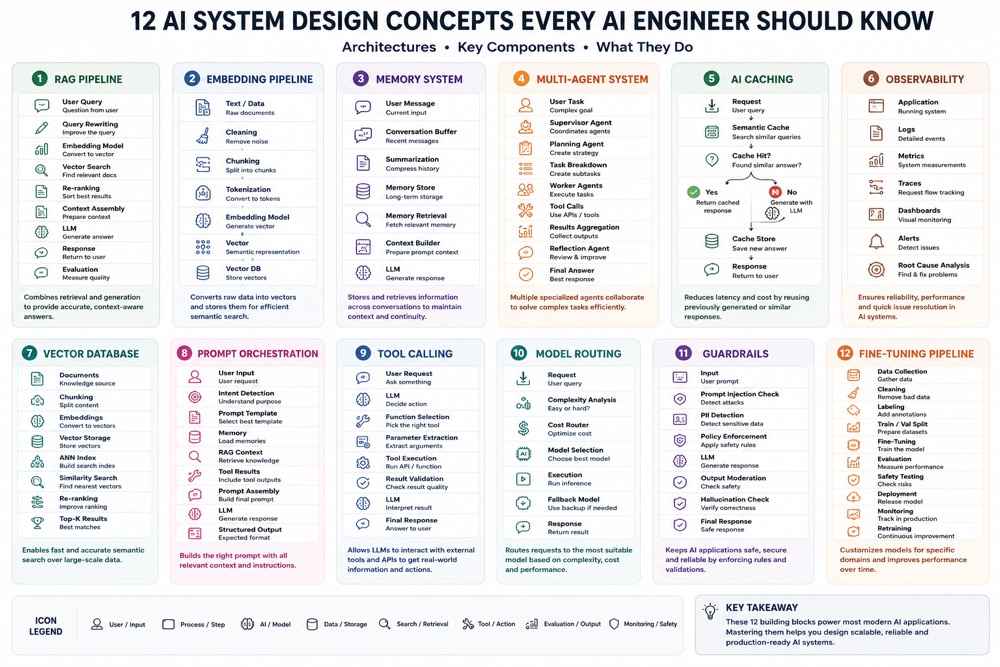
Artificial Intelligence has rapidly evolved beyond simple chatbots. Modern AI applications now combine large language models, retrieval systems, memory architectures, vector databases, tool calling, agent workflows, observability, and safety guardrails to deliver production-ready experiences.
Whether you’re building an AI assistant, a RAG-powered knowledge base, a voice agent, a multi-agent system, or preparing for AI System Design interviews, understanding the architectural building blocks behind these systems has become essential.
Many engineers learn individual technologies such as LLMs, embeddings, vector databases, or prompt engineering in isolation. However, real-world AI products are built by combining these components into scalable, reliable, and cost-effective architectures. Understanding how these pieces fit together is what separates an AI developer from an AI systems engineer.
In this guide, we’ll explore 12 fundamental AI system design concepts that appear repeatedly in modern AI products and enterprise deployments. For each architecture, we’ll examine both a simplified version and a production-grade implementation, along with the purpose of every component in the pipeline.
The concepts covered include:
- Retrieval-Augmented Generation (RAG)
- Embedding Pipelines
- Memory Systems
- Multi-Agent Architectures
- AI Caching
- Observability
- Vector Databases
- Prompt Orchestration
- Tool Calling
- Model Routing
- Guardrails
- Fine-Tuning Pipelines
By the end of this article, you’ll have a practical understanding of how modern AI systems are designed, how information flows through each architecture, and why these patterns are becoming standard knowledge for AI Engineers, Machine Learning Engineers, LLM Engineers, and AI Architects in 2026.
Let’s dive into the architectures that power today’s most advanced AI applications.
1. AI voice agent
User Speech
↓
Voice Activity Detection (VAD)
↓
Speech-to-Text (STT/ASR)
↓
Language Model (LLM)
↓
Text-to-Speech (TTS)
↓
Agent Response
Each stage adds delay:
- Voice Activity Detection (VAD) – Detects when speech starts/stops.
- Speech-to-Text (STT/ASR) – Converts audio into text.
- Language Model (LLM) – Generates the response.
- Text-to-Speech (TTS) – Converts the response back into audio.
Total Latency = VAD + STT + LLM + TTS
2. Agentic RAG
=====================================
Standard Version
========================================
↓
Planner
↓
Retriever
↓
Tool Calling
↓
Reasoning
↓
Answer
3. MCP (Model Context Protocol)
=====================================
Standard Version
========================================
↓
LLM
↓
MCP Client
↓
MCP Server
↓
Tool/Data Source
↓
Result
↓
LLM
4. AI Evaluation Pipeline
=====================================
Standard Version
========================================
↓
Dataset
↓
Model
↓
Evaluation
↓
Scores
↓
Regression Tests
5. Knowledge Graph + RAG
=====================================
Standard Version
========================================
↓
Entity Extraction
↓
Knowledge Graph
↓
Vector Search
↓
Context Merge
↓
LLM
6. RAG Pipeline
=====================================
Standard Version
========================================
User Query (User asks question)
Retriever (Find relevant documents)
↓
Vector DB (Stores embeddings for search)
↓
Context Injection (Add retrieved content to prompt)
↓
LLM (Generate answer)
↓
Response (Return answer)
========================================
Production Version
=====================================
User Query (Question)
↓
Query Rewriting (Improve search query)
↓
Embedding Model (Convert query to vector)
↓
Vector Search (Find similar documents)
↓
Re-ranking (Sort best matches)
↓
Context Assembly (Combine useful chunks)
↓
LLM (Generate answer)
↓
Response (Return answer)
↓
Evaluation (Measure quality)
7. Embedding Pipeline
=====================================
Standard Version
========================================
Text/Data (Input documents)
Tokenization (Split into tokens)
↓
Model Encoding (Convert tokens to vectors)
↓
Vector Output (Numerical representation)
↓
Storage (Save vectors)
========================================
Production Version
=====================================
Text (Raw content)
↓
Cleaning (Remove noise)
↓
Chunking (Split into smaller sections)
↓
Tokenization (Convert to tokens)
↓
Embedding Model (Generate vector)
↓
Vector (Semantic representation)
↓
Vector DB (Store vectors)
8. Memory System
=====================================
Standard Version
========================================
User Input (Current message)
↓
Short-Term Memory (Recent conversation)
↓
Long-Term Storage (Persistent memory)
↓
Retrieval (Find relevant memory)
↓
Context (Provide memory to LLM)
========================================
Production Version
=====================================
User Message (Current request)
↓
Conversation Buffer (Recent chat history)
↓
Summarization (Compress history)
↓
Memory Store (Save memory)
↓
Memory Retrieval (Fetch useful memory)
↓
Context Builder (Prepare prompt context)
↓
LLM (Generate answer)
9. Multi-Agent System
=====================================
Standard Version
========================================
Task (User goal)
↓
Planner Agent (Break work into steps)
↓
Subtasks (Smaller jobs)
↓
Worker Agents (Execute tasks)
↓
Aggregation (Combine results)
↓
Output (Final answer)
========================================
Production Version
=====================================
User Task (Complex request)
↓
Supervisor Agent (Coordinates agents)
↓
Planning Agent (Creates strategy)
↓
Task Breakdown (Creates subtasks)
↓
Worker Agents (Perform tasks)
↓
Tool Calls (Use APIs/tools)
↓
Results (Collected outputs)
↓
Reflection Agent (Review quality)
↓
Final Answer (Best response)
10. AI Caching
=====================================
Standard Version
========================================
Request (Incoming question)
↓
Cache Check (Already answered?)
↓
Hit/Miss (Found or not?)
↓
LLM (Generate if missing)
↓
Store (Save answer)
↓
Response (Return result)
========================================
Production Version
=====================================
Request (User query)
↓
Semantic Cache (Search similar questions)
↓
Hit? (Found similar answer?)
↙ ↘
Yes –> return No. –> LLM –> Cache Store –> Response
11. Observability
=====================================
Standard Version
========================================
Request (Incoming traffic)
↓
Logging (Store events)
↓
Metrics (Collect measurements)
↓
Tracing (Track request path)
↓
Alerts (Notify problems)
↓
Optimization (Improve system)
========================================
Production Version
=====================================
Application (Running service)
↓
Logs (Detailed events)
↓
Metrics (CPU, latency, errors)
↓
Distributed Trace (Track request flow)
↓
Dashboards (Visual monitoring)
↓
Alerts (Detect issues)
↓
Root Cause Analysis (Find problem source)
12. Vector Database
=====================================
Standard Version
========================================
Raw Data (Documents)
↓
Embeddings (Vectors)
↓
Indexing (Organize search)
↓
Similarity Search (Find similar vectors)
↓
Top-K Results (Best matches)
========================================
Production Version
=====================================
Documents (Knowledge source)
↓
Chunking (Split content)
↓
Embeddings (Convert to vectors)
↓
Vector Storage (Save vectors)
↓
ANN Index (Fast search index)
↓
Similarity Search (Nearest neighbors)
↓
Re-ranking (Improve ranking)
↓
Top-K Results (Best documents)
13. Prompt Orchestration
=====================================
Standard Version
========================================
Input (User request)
↓
Prompt Template (Prompt structure)
↓
Context Injection (Add information)
↓
LLM (Generate response)
↓
Structured Output (JSON/Table/etc.)
========================================
Production Version
=====================================
Input (User request)
↓
Intent Detection (Determine purpose)
↓
Prompt Template (Select template)
↓
Memory (Load memories)
↓
RAG Context (Load documents)
↓
Tool Results (API outputs)
↓
Prompt Assembly (Build final prompt)
↓
LLM (Generate answer)
↓
Structured Output (Expected format)
14. Tool Calling
=====================================
Standard Version
========================================
User Request (Question)
↓
LLM (Decide action)
↓
Tool Selection (Choose tool)
↓
API Call (Execute tool)
↓
Response (Tool result)
↓
Output (Final answer)
========================================
Production Version
=====================================
User Request (Input)
↓
LLM (Reasoning)
↓
Function Selection (Pick function)
↓
Parameter Extraction (Fill arguments)
↓
Tool Execution (Run API)
↓
Result Validation (Verify result)
↓
LLM (Interpret result)
↓
Final Response (Answer user)
15. Model Routing
=====================================
Standard Version
========================================
Request (User query)
↓
Classifier (Categorize request)
↓
Model Selection (Choose model)
↓
Execution (Run model)
↓
Response (Return result)
========================================
Production Version
=====================================
Request (User query)
↓
Complexity Analysis (Easy or hard?)
↓
Cost Router (Optimize cost)
↓
Model Selection (Choose best model)
↓
Execution (Run inference)
↓
Fallback Model (Backup model)
↓
Response (Final answer)
16. Guardrails
=====================================
Standard Version
========================================
Input (User request)
↓
Validation (Check format)
↓
Policy Check (Safety rules)
↓
LLM (Generate answer)
↓
Output Filter (Check response)
↓
Final Response (Safe answer)
========================================
Production Version
=====================================
Input (User prompt)
↓
Prompt Injection Check (Detect attacks)
↓
PII Detection (Detect sensitive data)
↓
Policy Enforcement (Apply rules)
↓
LLM (Generate answer)
↓
Output Moderation (Check safety)
↓
Hallucination Detection (Check correctness)
↓
Final Response (Safe response)
17. Finetuning Pipeline
=====================================
Standard Version
========================================
Dataset (Training data)
↓
Preprocessing (Clean data)
↓
Training (Learn patterns)
↓
Evaluation (Measure accuracy)
↓
Deployment (Release model)
↓
Monitoring (Watch performance)
========================================
Production Version
=====================================
Data Collection (Gather data)
↓
Cleaning (Remove bad data)
↓
Labeling (Add annotations)
↓
Train/Validation Split (Separate datasets)
↓
Fine-Tuning (Train model)
↓
Evaluation (Measure quality)
↓
Safety Testing (Check risks)
↓
Deployment (Release model)
↓
Monitoring (Track performance)
↓
Retraining (Continuous improvement)
Think of AI systems as 5 layers:
Data Layer
├─ Embeddings
├─ Vector DB
└─ Fine-Tuning
Knowledge Layer
├─ RAG
├─ Memory
└─ Caching
Reasoning Layer
├─ LLM
├─ Multi-Agent
└─ Tool Calling
Control Layer
├─ Routing
├─ Prompt Orchestration
└─ Guardrails
Operations Layer
├─ Observability
└─ Monitoring
Interview Explanation
Question: What is ASR in a voice agent?
Answer:
ASR (Automatic Speech Recognition) is the component that converts spoken audio into text so that downstream components such as language models can understand and process user input.

There are 0 comments