

The Rule of Three: Why Great Software Engineers Don’t Abstract Too Early
Software engineering is full of principles that promise cleaner, more maintainable code. Among them, one simple guideline has saved countless developers from over-engineering their projects:
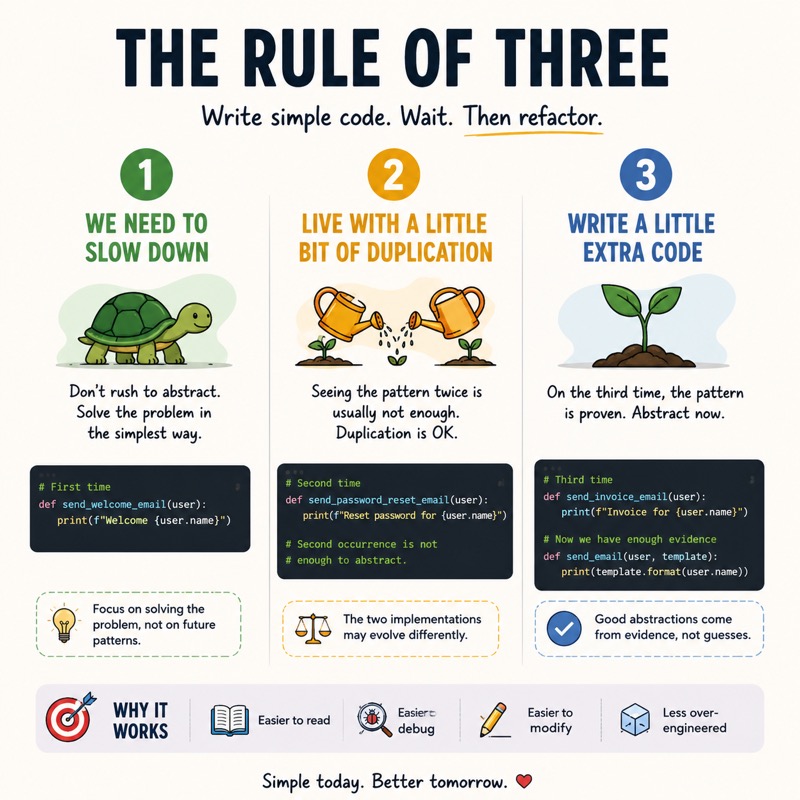
The Rule of Three
At first glance, it may seem to encourage writing duplicate code. In reality, it promotes something far more valuable: waiting until a pattern is proven before introducing abstractions.
What Is the Rule of Three?
The Rule of Three suggests that you should avoid creating reusable abstractions until you’ve encountered the same problem at least three times.
It can be summarized in three simple ideas:
1. Slow Down
When implementing a feature for the first time, resist the urge to build a generic framework.
Solve today’s problem.
Not tomorrow’s hypothetical problem.
Many developers create base classes, interfaces, factories, and helper libraries before they know whether they’ll actually need them.
The result is often unnecessary complexity.
2. Live with a Little Duplication
Suppose you implement similar logic a second time.
Your instinct may be to immediately refactor both implementations into a common abstraction.
Don’t.
Two similar pieces of code may evolve differently as requirements change.
A little duplication is often less harmful than introducing an abstraction that turns out to be wrong.
Temporary duplication gives your design room to evolve naturally.
3. Write a Little Extra Code
By the third occurrence, the pattern is no longer a coincidence.
Now you have enough evidence to create a reusable abstraction.
Instead of optimizing for imagined future requirements, you’re optimizing for real, observed behavior.
Your abstraction is based on facts rather than assumptions.
An Example
Imagine you’re building an application that sends emails.
First feature
def send_welcome_email(user):
    print(f"Welcome {user.name}")
Nothing to abstract.
Second feature
def send_password_reset_email(user):
    print(f"Reset password for {user.name}")
Yes, the functions look similar.
But resist creating a generic email framework.
Password reset emails may eventually require security logging, expiration links, or additional verification.
The welcome email probably won’t.
Third feature
def send_invoice_email(user):
    print(f"Invoice for {user.name}")
Now a clear pattern has emerged.
Creating something like this makes sense:
def send_email(user, template):
    print(template.format(user.name))
Because you’ve already seen multiple real use cases, the abstraction has a much better chance of being correct.
Why Premature Abstraction Can Hurt
Developers often try to predict future requirements.
Unfortunately, software requirements change.
An abstraction created too early may become:
- difficult to understand
- difficult to extend
- tightly coupled
- filled with unnecessary configuration
- harder to debug
Ironically, code written to make future changes easier often makes today’s code harder to maintain.
Why Experienced Engineers Appreciate This Principle
The Rule of Three encourages software that is:
- Easier to read
- Easier to debug
- Easier to test
- Easier to modify
- Less coupled
- Less over-engineered
Simple code tends to survive longer than clever code.
How It Relates to Other Engineering Principles
The Rule of Three complements several well-known software engineering concepts.
DRY (Don’t Repeat Yourself)
DRY teaches us to remove unnecessary duplication.
The Rule of Three reminds us that not all duplication is unnecessary.
Sometimes duplication is simply evidence gathering.
YAGNI (You Aren’t Gonna Need It)
Don’t build functionality until you actually need it.
The Rule of Three is one practical way to apply YAGNI in everyday coding.
KISS (Keep It Simple, Stupid)
Simple solutions are usually better than complex ones.
Waiting before abstracting naturally keeps your design simpler.
When Should You Ignore the Rule?
Like any engineering guideline, there are exceptions.
Examples include:
- Security-critical code where duplication increases risk
- Well-established algorithms with known reusable structures
- Public SDKs and frameworks that require carefully designed APIs
- Performance-sensitive systems with established architectural patterns
Good engineering is about judgment, not rigid rules.
A Practical Mindset
Whenever you notice repeated code, ask yourself:
- Is this the second time I’ve seen this pattern?
- Could these implementations evolve differently?
- Am I solving today’s problem or tomorrow’s guess?
If the answer is “I’ve only seen this once or twice,” it may be worth waiting.
If it’s the third time, you’ve likely gathered enough evidence to refactor with confidence.
Final Thoughts
The Rule of Three isn’t about encouraging duplicate code.
It’s about earning your abstractions.
Instead of trying to predict the future, let your software reveal its natural patterns over time.
Some duplication today can lead to cleaner architecture tomorrow.
The next time you’re tempted to create a new base class, helper, or framework after writing similar code twice, pause for a moment.
Ask yourself:
“Has this pattern truly earned an abstraction?”
Often, waiting just a little longer leads to simpler, more maintainable software.
Key Takeaways
✅ Solve today’s problem first.
✅ Accept a small amount of temporary duplication.
✅ Refactor only after a pattern has been proven.
✅ Let real requirements shape your architecture.
✅ Simple code is often the most maintainable code.

There are 0 comments